
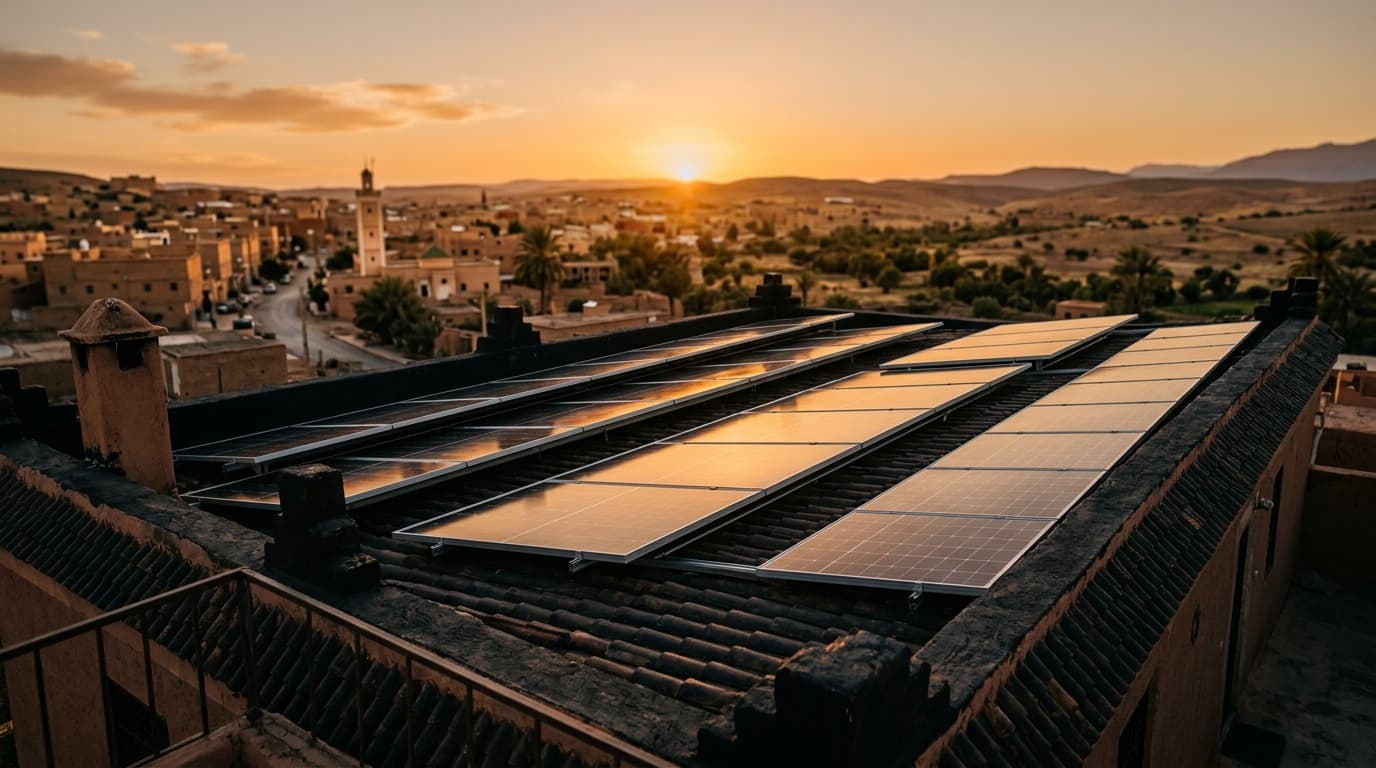
Putting solar panels on your roof is an appealing idea in Taza, where sunshine is never in short supply. But before committing, the real question is not only how much does it cost, but how long does the system take to pay for itself. This guide explains, concretely and honestly, the elements that determine that return in the Moroccan context.
Why Taza suits photovoltaics well
Morocco enjoys some of the highest solar irradiation in the Mediterranean region. Inland areas such as Taza receive a large number of useful sun hours per year, which means the same panel produces more electricity here than it would in cloudier parts of Europe. This abundant solar resource is the starting point of the whole economic logic: the more radiation your roof receives, the harder each dirham invested in panels works for you.
That said, sunshine alone guarantees nothing. Roof orientation, the absence of shading (trees, neighbouring buildings), and the quality of the installation matter just as much.
The components of a residential system
A home installation rests on a few main elements:
- The photovoltaic panels (modules): they convert light into direct-current electricity. Their total power is measured in kilowatts-peak (kWp).
- The inverter: it turns the panels' direct current into alternating current the house can use. It is a central component, to be chosen with care.
- The mounting structure: rails and supports that hold the panels on the roof at the right tilt.
- A battery (optional): it stores the surplus produced during the day for evening use. It increases autonomy but also, noticeably, the cost.
Self-consumption versus grid export
In Morocco, residential electricity is generally distributed by ONEE or by local utilities. For a household, the simplest and most common model is self-consumption: solar electricity is used directly in the home at the moment it is produced, reducing what you buy from the grid by the same amount.
The idea of exporting the surplus to the grid and being credited for it exists, but the regulatory framework and conditions for small residential systems evolve and vary. Do not assume your surplus will be bought back at a favourable rate: check the current rules with your distributor before sizing the system. In practice, the most reliable saving remains the electricity you do not buy, not the electricity you resell.
What really drives the payback
Several factors determine how fast the system pays for itself:
- System size (kWp): a system correctly sized for your needs avoids paying for production you do not consume.
- Roof orientation and tilt: a due-south exposure, free of shade, maximises production.
- Your consumption profile: if you use a lot of power during the day (air conditioning, a pump, remote work), self-consumption is highly profitable. If your consumption is mostly in the evening, a battery becomes more relevant.
- The electricity tariff: the higher the price of the kWh you buy from the grid, the greater your savings. Tariffs are often progressive, banded by consumption tier.
- Adding a battery: it improves comfort and autonomy, but generally lengthens the payback period.
As a purely illustrative example: a small residential installation might represent an investment on the order of a few tens of thousands of dirhams, and generate annual bill savings that, in a favourable case, point to a payback over several years. These figures are only examples: only an on-site assessment and a detailed quote give reliable values.
Maintenance and lifespan
One advantage of photovoltaics is its light maintenance. It comes down mainly to:
- A periodic cleaning of the panels, especially after dust or wind events, since dirt reduces output.
- A visual check of the mountings and cables.
- Monitoring production through the inverter's app to spot any abnormal drop.
Panels generally have a long lifespan, while the inverter may need to be replaced once over the life of the installation: a cost to anticipate in the calculation.
Thinking about payback realistically
The best approach is not to hunt for a magic number, but to reason in ranges. A payback depends on too many local variables to be promised in advance. Be wary of any promise that is too precise or too fast. The sensible path is to have your roof assessed, analyse your actual bill, and compare several scenarios (with or without a battery, different sizes).
SmartJar designs and installs residential solar systems in the Taza region. If you would like figures tailored to your home rather than averages, an on-site assessment remains the only way to obtain a reliable estimate of your return on investment.